
Three Good Books About the Current State of American Evangelicalism
Brief thoughts on personal works of journalism by Jon Ward, Sarah McCammon, and Tim Alberta


I’ve long been fascinated with the ways the worlds of politics and religion intersect, specifically with the dark turn that overlap has taken within the past ten years as it concerns evangelical Christianity and right-wing politics. Within the past year, I’ve read three books that delve deeper into the crisis—largely self-created—that American Christianity has found itself in over the course of those past ten years. Aside from the subject matter, the books are all quite different, but each is excellent in its own way. All three are written by journalists by trade, so there is an element of the investigative along with, to varying degrees, elements of each author’s personal faith story. Illuminating reportage mixed with stirring memoir.
I can be quite nerdy about this sort of thing. Personal spiritual narratives mixed with objective reporting on and deserved criticism of the American church are my sweet spot. I am always on the lookout for memoirs written by people raised in a similar church environment and Christian culture as me, and these books each fit that bill to certain unique extents. What follows are some brief thoughts about them. (Bets on if I can actually keep it brief?)
Testimony: Inside the Evangelical Movement That Failed a Generation by Jon Ward
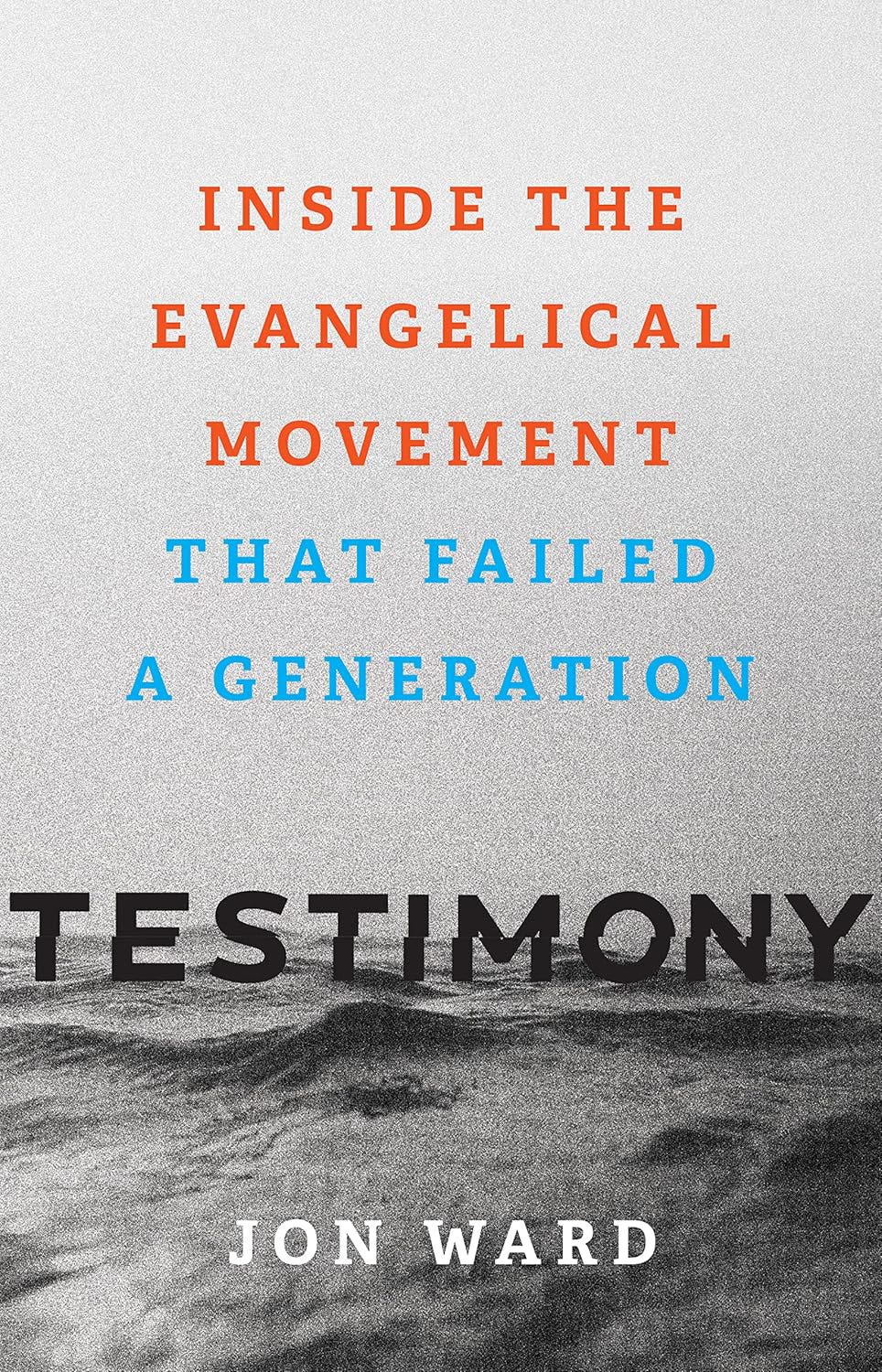
My memory is a little foggy on this one because I read it over a year ago, but the subtitle gives you a pretty good gist of what to expect. Ward, a former political reporter with Yahoo! News, writes about his experience of growing up attending the church that famed pastor CJ Mahaney headed up. Though Mahaney is a minister in the denomination known as Sovereign Grace Churches, which has a charismatic bent, I remember him as a star even in Southern Baptist circles back when I was thinking about going into ministry some twenty odd years ago.
He was an SBC (Southern Baptist Convention) star because he is “Reformed,” which is another word for “Calvinist,” which is another word for “believer in predestination” (among other hardline beliefs), which means he believes some people were predestined to go to heaven and others to hell before they were even born—sorry about your luck, pal. And many Southern Baptists are proud—and adamant—Calvinists. I should know, I used to be one.
Ward’s book is an account of his breaking free from this kind of stringent, inflexible theology, and it’s also a story of coming to grips with a pastor he thought he knew, for early in the 2010s Mahaney became embroiled in a controversy revolving pretty much around the fact that he was a megalomaniacal jerk to his staff while at the same time preaching a rigid standard of morality from the pulpit. His denomination also became caught up in an alleged child abuse cover-up, which Ward recounts as well. And then, there is, of course, the evangelical alignment with Donald Trump that shocked and angered so many level-headed Christians to the point of taking a serious reexamination of their beliefs, Ward included.
Ward is a good, effective writer, though I remember some of the longer passages of exposition and background information dragging a bit, which, to be fair, is probably a “me” problem more than anything. He is deft at straddling the line between criticizing evangelicalism’s colossal failures and simply attacking evangelicalism outright. The topic of writing and journalism is also near and dear to Ward’s heart, and I was reminded of my brief interest in studying journalism in college. He’s able to conjure up that youthful excitement again while at the same time use those journalistic talents and writing skills to weave a compelling story with the precision of someone who cares about what the truth is and getting to the bottom of it, all of which makes Testimony an enlightening and worthwhile read.
Key Passages:
“The New Calvinism…turned me and everyone else in on ourselves in an endless search for imperfections. If we were totally depraved, there was no end to the work we could do to search out the ways in which were actively offending God and to be in constant repentance. We called this the ‘doctrine of indwelling sin.’” (pg. 76)
There is big talk about grace in Calvinism (it’s said to be irresistible), but the theology by its very nature can cause one to become obsessive about every single smallest, even possible hint of a sin, which begins to take a mental toll. One can begin to question their self-worth, which is unsurprising given that the idea “self-esteem” is considered by many in this camp to be one of America’s greatest evils.
“I did not want to mislead my children. What could I tell them that I knew was true, and what could I tell them that I hoped was true? Where did knowledge end and where did faith begin?” (pg. 196)
What a question! Many deconstruction stories involve parents re-examining their faith in order to figure out what they do and do not want to teach their children, and how exactly they want to broach the topic of spirituality and religion in general.
Jon Ward’s Substack: Border-Stalkers
The Exvangelicals: Loving, Living, and Leaving the White Evangelical Church by Sarah McCammon
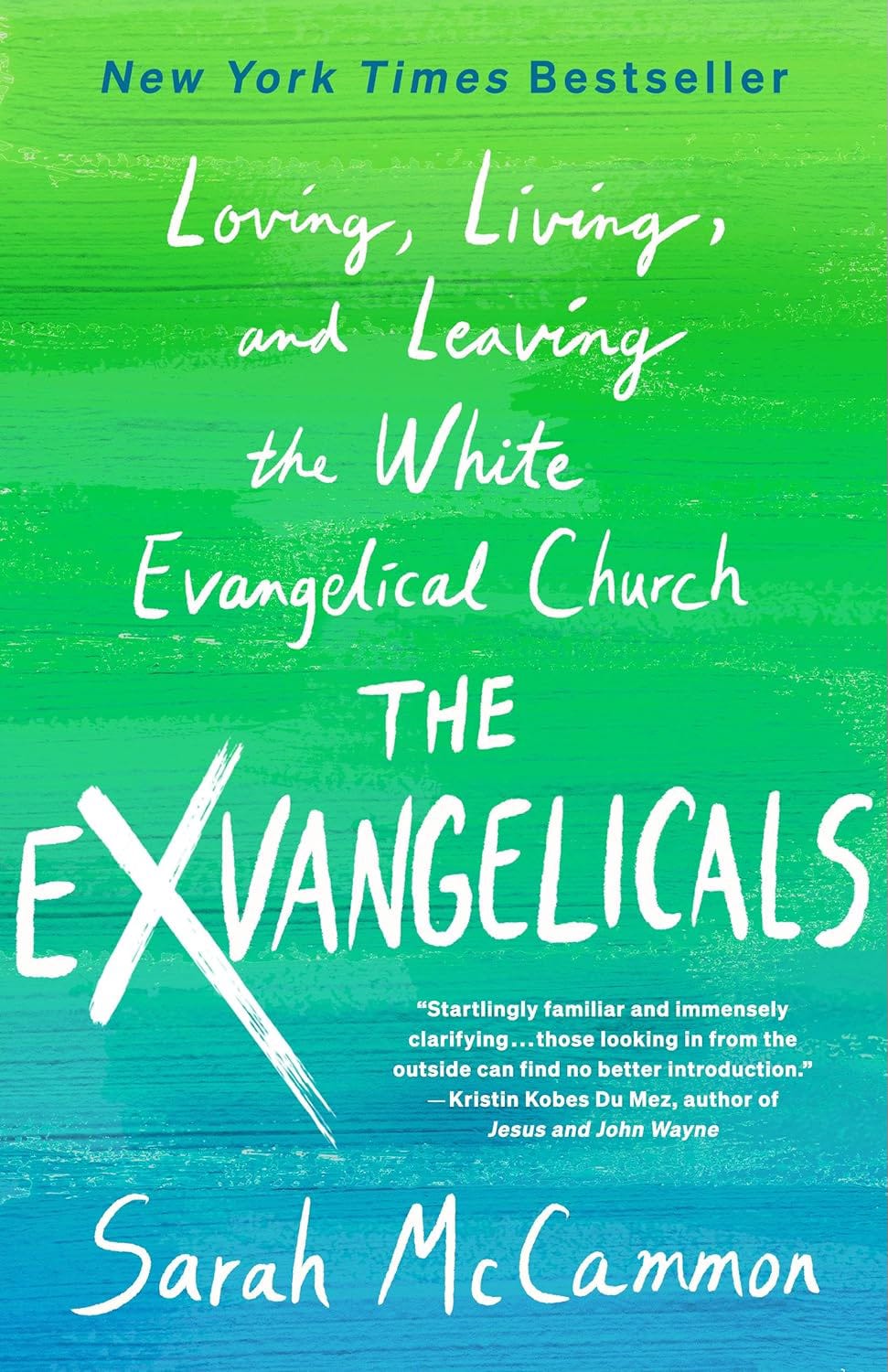
Though I enjoyed each of these three books, McCammon’s might be my personal favorite simply because her story resonates so much with mine. She is a political reporter and correspondent for NPR, and she brings that experience to bear in the form of multiple interviews with ex-evangelicals over the course of the book. Mixed in with these interviews is the story of her own faith deconstruction, wherein she recounts how she decided to leave evangelicalism behind long before Trump was on anyone’s radar, much like myself (though I tried to come back around a time or two). But it was that coalescing—of all things Trumpian with American evangelism—that again piqued her interest in what was happening in and to the church, and what she discovered is that a lot of folks were leaving. A lot.
So many quotes from interviews and revelations from McCammon’s own life sound like they could have been ripped straight from my own story (which I gave a general outline of here).
She writes with the care, precision, and curiosity of a good journalist and the heart of an empathetic storyteller. The story of her relationship with her non-religious grandfather lends the book some added emotional heft, though the interviews with everyday folks who found themselves caught up in the evangelical trenches contain plenty of emotional revelations on their own.
Key Passages:
“Peace has come not from praying harder, but from letting go of the idea that she has to save anyone.” (p. 30)
This is McCammon describing one of her interview subjects but probably applies to just about all of them indirectly. So much could be said about this one idea alone. Here, I’ll just say I resonate so much with this. It’s incredibly freeing when you come to the realization that someone’s eternal resting place does not depend on you convincing them to believe a certain way because you think that is the only right way to believe.
“I’d become overwhelmed with obsessive thoughts about going to Hell, and fearful that I would commit the ‘unforgivable sin’—a mysterious idea mentioned in passing in the New Testament, which had haunted me from the first moment I heard of it as a small child. The thought was that there was something I could do that was beyond the reach of God’s forgiveness terrified me, and often kept me awake at night. Intrusive thoughts would slip in randomly, at any moment—during the school day or a summer day at the swimming pool—and suddenly I’d be gripped by fear.” (p. 190-191)
As many young and budding evangelicals were (and, I’m sure, are), I was obsessed with the idea of Hell, fearful that’s where I’d end up even though I was “saved,” and the “unforgivable sin,” which is blaspheming against the Holy Spirit, seemed to change based on however people wanted to interpret the word “blaspheming” to apply to a particular situation. I’d never heard anyone say that obsessions over these spiritual and dogmatic matters can lead to intrusive thoughts, but that is exactly what happened to me. I remember random friends or family members popping into my head because I would suddenly be fearful they were hellbound due to not being Christian, or at least not the right kind of Christian. And I remember thinking, Is this what it means to suffer for God? Does God want me to live in psychological torture like this? Super healthy stuff!
Sarah McCammon’s Substack: Off the Air: A Journalist’s After-Hours Thoughts
The Kingdom, the Power, and the Glory: American Evangelicals in an Age of Extremism by Tim Alberta
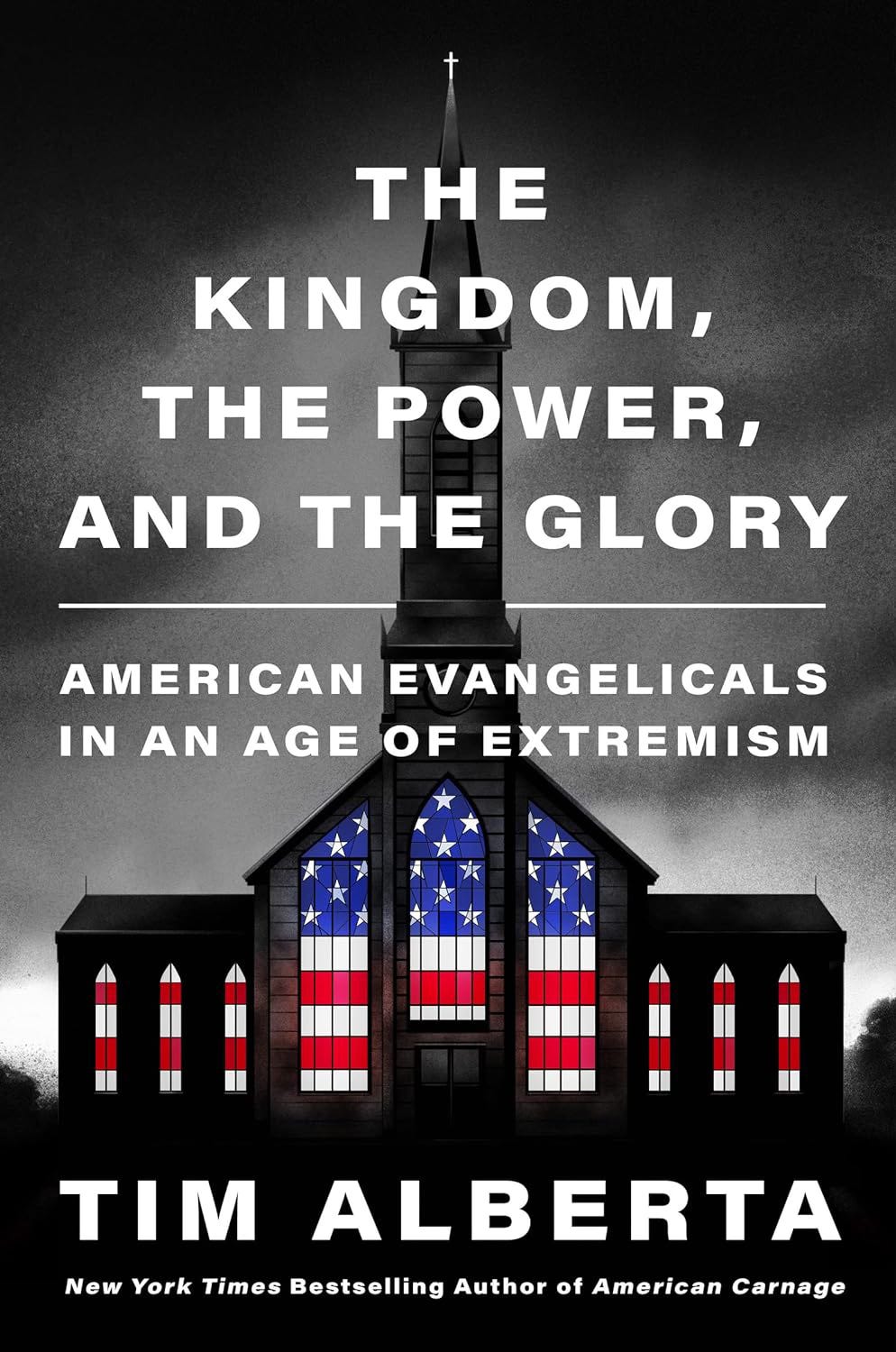
This is the most purely journalistic book of the three, but no less effective. What makes it so interesting is that Alberta, long time staff writer for The Atlantic magazine, is still a conservative evangelical, a fact which he makes known throughout the book, quoting scripture and giving his own prescriptive opinions about what American evangelicalism could still be.
The “Extremism” in the title is a stand-in for those who’ve embraced right-wing Christian nationalism and Trump as its de facto leader and most efficient conduit. The introduction includes Alberta attending the funeral of his pastor father, and being confronted there by parishioners over his recent criticisms of Rush Limbaugh. At his father’s funeral. Cult much?
He interviews such people as Jerry Falwell, Jr., former president of Liberty University, one of the largest Christian universities in the country; Greg Locke, viral gun-loving, possibly sociopathic preacher; and Robert Jeffress, Trump-loving, aw-shucks pastor of First Baptist Church in Dallas. Alberta gleans revelations and confessions both typical and surprising from these right-wing firebrands, particularly as it pertains to any regrets they might have about their alliance with—nay, allegiance to—Donald Trump. These interviews are counterbalanced with folks who didn’t drink the Kool-aid, like Russell Moore, former SBC-stalwart and current editor of Christianity Today; and David French, conservative columnist for the New York Times disgraced and denigrated as too liberal by conservative extremists because he’s convictionally anti-Trump (in his latest column he actually states that he’s voting for Kamala Harris).
Simply put, as a work of journalism and reportage, this book is outstanding. Alberta writes with utter efficiency and clarity, if not always artfulness, and in such a way that I was on the edge of my seat and flabbergasted in equal measure while reading. His personal asides for the most part are fine, but there are a few too many instances where he talks about things like having a “personal relationship with Jesus Christ so that you can spend eternity with him,” cliches that ring a bit hollow for me nowadays, particularly since the implication every time such a phrase is uttered, whether intentional or not, is that without this relationship you will be lit aflame for eternity. It comes across at times as a little out of place.
But, really, that’s neither here nor there, and in the grand scheme of the book, these asides are few and far between. And in some ways, these asides are what make the book so unique and what make me so grateful for it: because Tim Alberta is still an insider, unafraid to call bullshit on evangelical fealty to Trump by letting the more cult-like of his followers’ words do the talking for him. I don’t have to agree with him theologically to appreciate that.
Key Passages:
“Humility doesn’t come easy to the American evangelical. The self-importance that accompanies citizenship in the world’s mightiest nation is trouble enough, never mind when it’s augmented by the certainty of exclusive membership in the afterlife. We are an immodest and excessively indulged people. We have grown so accustomed to our advantages—to our prosperity and our worldly position—that we feel entitled to them.”
In the words of country singer Mac Davis, “Oh Lord, it’s hard to be humble”—when you think that you and folks who believe exactly as you do are the heavenly chosen ones, and no one else.
“More than any figure in American history, the forty-fifth president transformed evangelical from spiritual signifier into political punch line, exposing the selective morality and ethical inconsistency and rank hypocrisy that had for so long lurked in the subconscious of the movement.”
This statement absolutely nails the tailspin that Trump threw American evangelicalism into. But he really just tapped into something that was already there bubbling underneath the surface, and he turned it into a gusher.
Related Posts I’ve Written: